Pythagorean vs Chaldean numerology: which system to use
Updated October 12, 2026 · 7-minute read · 7 sections
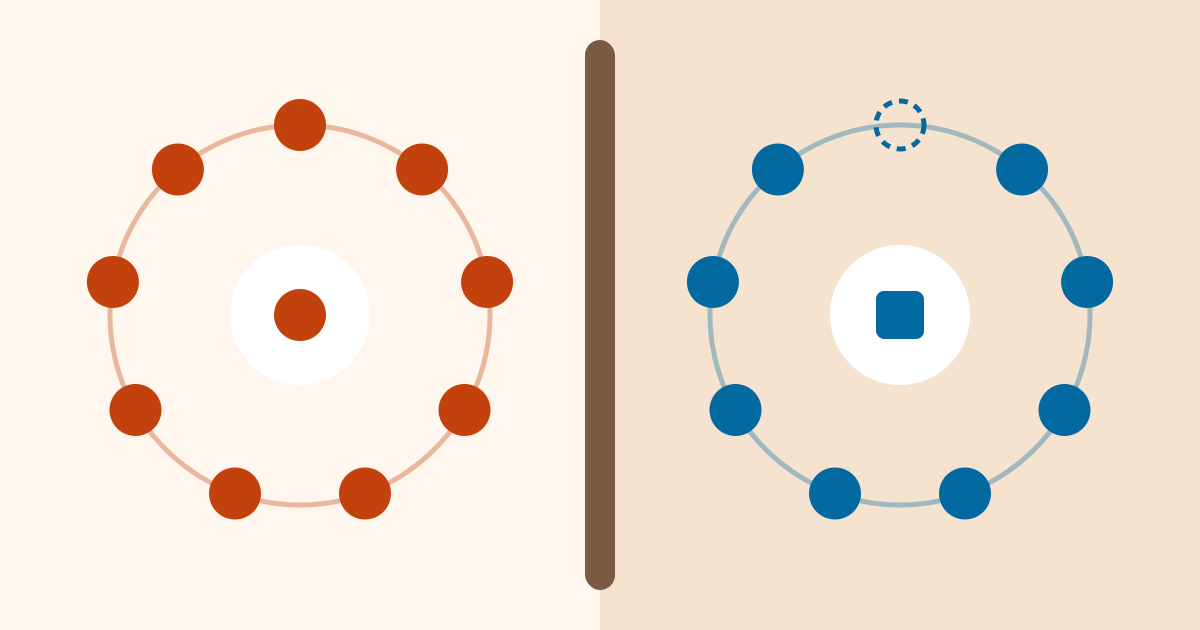
Pythagorean vs Chaldean numerology is the first fork in the road for anyone who calculates a name: two systems, two letter tables, and often two different answers for the same person. Pythagorean counts the alphabet from 1 to 9 and keeps master numbers; Chaldean groups letters by sound, uses 1 to 8 only and reads compound numbers. Below are both tables, one name calculated both ways, and how I choose.
Pythagorean vs Chaldean numerology at a glance
| Pythagorean | Chaldean | |
|---|---|---|
| Letter values | 1 to 9, in alphabet order, repeating | 1 to 8 only, grouped by sound |
| The number 9 | Given to I and R | Given to no letter |
| Which name | Full birth name first | The name you are commonly known by |
| Master numbers | 11, 22, 33 kept | Not used the same way; compound numbers are read instead |
| Compound numbers | Noticed mainly for karmic debt | Read before reducing, each with its own meaning |
| Date numbers | Life Path, reduced | Reduced the same way |
The usual story credits Pythagoras for one and ancient Chaldea for the other. Take the names as labels for two traditions, not as proof of age: the forms in use today are modern Western practice, and the A-to-Z cycle in particular is a convenience, not an ancient inscription.
The two letter tables
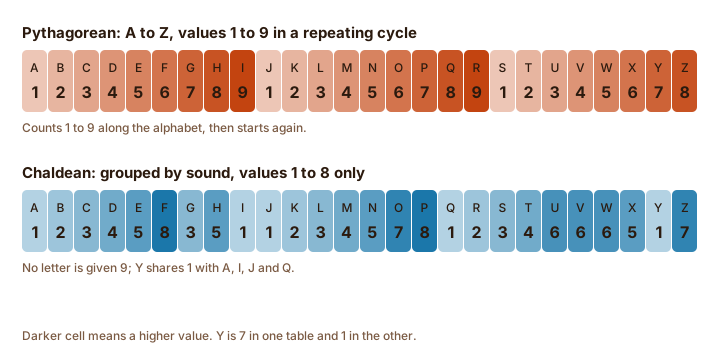
| Value | Pythagorean | Chaldean |
|---|---|---|
| 1 | A J S | A I J Q Y |
| 2 | B K T | B K R |
| 3 | C L U | C G L S |
| 4 | D M V | D M T |
| 5 | E N W | E H N X |
| 6 | F O X | U V W |
| 7 | G P Y | O Z |
| 8 | H Q Z | F P |
| 9 | I R | none |
The tables are the whole difference in practice. Ten letters (A, B, C, D, E, J, K, L, M, N) carry the same value in both; the other sixteen do not, which is why one name rarely gives the same number twice.
Why Chaldean has no 9
Chaldean values run from 1 to 8 and stop. The tradition treats 9 as sacred, a number too complete to hang on a single letter, so it appears only as a total, never as a letter value. Letters are placed by the sound and vibration they are said to carry, not by alphabet position, which is why F and P share an 8 and A, I, J, Q and Y share a 1. I would not claim the grouping can be proved; it is a convention, and its virtue is that it is consistent. LoveToKnow's Chaldean guide gives the same chart.
Compound numbers: the Chaldean second layer
In Pythagorean work you add and reduce, and the only intermediate totals anyone looks at are master numbers and karmic debts. Chaldean readers keep the compound number, the total before the last reduction, as a reading in itself. Totals such as 20, 11, 29 and 38 all reduce to 2, but they are not read as the same 2: the single digit gives the broad colour, the compound the detail.
Chaldean practice also takes each part of a name separately, first, middle and last, before the whole. The parts are where a Chaldean chart gets its texture, and I recommend the habit even to Pythagorean students. The calculator works that way in both systems: it reduces each part, adds the reduced parts and reduces again, and it shows the compound beside the result.
The same name in both systems
Using the made-up names from the other guides, here is each part of each name converted both ways. Check any line against the tables above.
| Name part | Pythagorean | Chaldean |
|---|---|---|
| Maya | 4 + 1 + 7 + 1 = 13 | 4 + 1 + 1 + 1 = 7 |
| Lynn | 3 + 7 + 5 + 5 = 20 | 3 + 1 + 5 + 5 = 14 |
| Hartley | 8 + 1 + 9 + 2 + 3 + 5 + 7 = 35 | 5 + 1 + 2 + 4 + 3 + 5 + 1 = 21 |
| Maya Lynn Hartley | 13 → 4, 20 → 2, 35 → 8; 4 + 2 + 8 = 14, then 5 (all letters: 68 → 14 → 5) | 7, 14 → 5, 21 → 3; 7 + 5 + 3 = 15, then 6 (all letters: 42 → 6) |
| Daniel | 4 + 1 + 5 + 9 + 5 + 3 = 27 | 4 + 1 + 5 + 1 + 5 + 3 = 19 |
| Roy | 9 + 6 + 7 = 22 | 2 + 7 + 1 = 10 |
| Kingsley | 2 + 9 + 5 + 7 + 1 + 3 + 5 + 7 = 39 | 2 + 1 + 5 + 3 + 3 + 3 + 5 + 1 = 23 |
| Daniel Roy Kingsley | 27 → 9, 22 (kept), 39 → 3; 9 + 22 + 3 = 34, then 7 (all letters: 88 → 16 → 7) | 19 → 1, 10 → 1, 23 → 5; 1 + 1 + 5 = 7, so 7 (all letters: 52 → 7) |
Maya Lynn Hartley is a 5 in Pythagorean and a 6 in Chaldean. Daniel Roy Kingsley is a 7 in both, but by different roads: adding all the Pythagorean letters passes through a karmic debt 16 (88 → 16 → 7), while reducing each part first reaches 34 with no debt, and the Chaldean compound is 52 with all letters or 7 part by part. A matching final digit is a coincidence, so I never read it as confirmation; the compound tells you more.
One letter does much of the damage: Y is 7 in Pythagorean and 1 in Chaldean, a swing of six points for every Y. Check the Y first when two results disagree. How Y is split between vowel and consonant is covered in Expression, Soul Urge and Personality numbers explained.
Dates work the same way in both
The Life Path comes from the birth date and never touches the letter table, so both systems reduce it alike. What changes with the system is the name. Master numbers and karmic debt, covered in master numbers 11, 22, 33 and karmic debt, are Pythagorean-world ideas; a Chaldean reader looks at the compound instead. The calculator applies its master-number and karmic-debt checks to both tables and also shows the compound.
How to choose a system
- Start with the question. A reading of a person from the birth certificate name, with Life Path, master numbers and karmic debt: Pythagorean. A reading of the name someone lives under, such as a stage name or a brand: Chaldean fits well, because it works from the name as spoken and known.
- Decide before you look. Pick the system on principle, then calculate. Running both and keeping the answer you like is the one habit I would never defend.
- Compare afterwards, for learning. Run both once and note what repeats. A theme that survives both tables is worth more than a number that shows up in one.
- Stay consistent. Never mix Pythagorean values with Chaldean rules, or give a Chaldean letter a 9. Write the system beside every result you keep.
If you want only one system, take Pythagorean: far more teaching material, and nearly every calculator offers it. Add Chaldean the moment a used name or business name matters more than the birth certificate. The numerology calculator has a switch for both, and RoxyAPI's comparison lists both algorithms if you want to build your own.
Both systems are traditions for reflection, not sciences, and neither predicts events. Treat the numbers as prompts, never as advice on health, money or law.
Quick answers
What is the difference between Pythagorean and Chaldean numerology?
Pythagorean assigns letter values 1 to 9 in alphabetical order and keeps master numbers; Chaldean groups letters by sound with values 1 to 8 and reads compound numbers. They often give different results for the same name.
Why does Chaldean numerology not use the number 9?
The tradition treats 9 as sacred, so no letter is given it; 9 can appear only as a total. Letters are grouped by sound and use values 1 to 8.
Which system should I use, Pythagorean or Chaldean?
Pythagorean suits a birth-name reading with Life Path, master numbers and karmic debt. Chaldean suits the name someone is commonly known by. Decide before you calculate and stay consistent.
Do both systems give the same Life Path?
Yes. The Life Path comes from the birth date, which is reduced the same way in both. The difference is in the letter values for the name numbers.
Why do Pythagorean and Chaldean give different numbers for my name?
Sixteen of the 26 letters carry different values in the two tables; Y, for example, is 7 in Pythagorean and 1 in Chaldean, so the totals differ.